


Ground Instrumentation
SKA

Radio telescope tackling fundamental questions such as the formation of the first stars and galaxies or the behaviour of gravity and dark energy
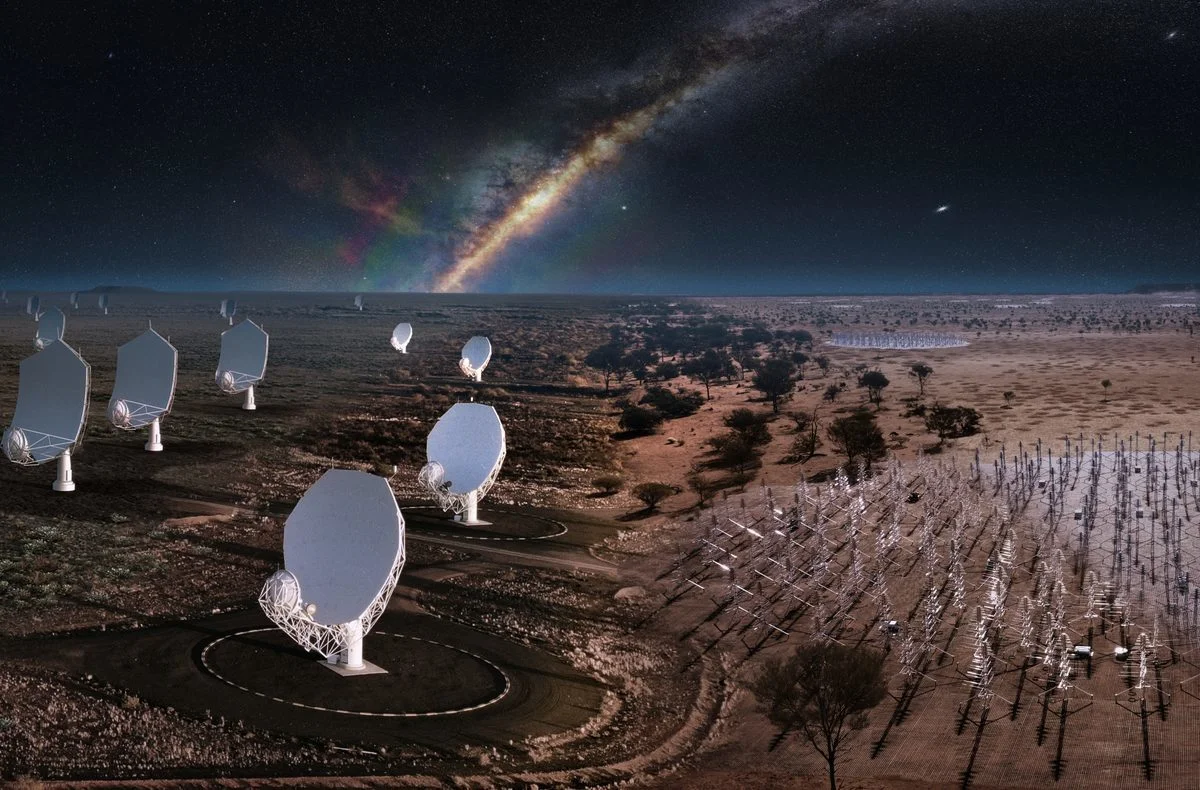
The Square Kilometre Array (SKA) is an international project to build the largest radio telescope, designed to explore in unprecedented detail the formation of galaxies, dark energy and other enigmas of the universe.
SKA is a global radio astronomy project that aims to build the world’s largest and most powerful radio telescope, spread across Australia and South Africa. Ten other countries, including Spain, are involved in the project. Its main science goals focus on addressing fundamental questions in astrophysics, such as understanding the formation of galaxies, stars, and black holes, as well as probing the early universe to explore the cosmic dawn—when the universe transitions from complete darkness to the first visible sources of light—and the epoch of reionisation—when the light from the first stars and galaxies ionised the surrounding hydrogen gas. Additionally, SKA aims to study the nature of dark matter and dark energy, map the magnetic fields in galaxies, and search for extraterrestrial life, among others.
The SKA Observatory (SKAO) will consist of two major components: the SKA-Low and SKA-Mid arrays. SKA-Low, located in Australia, will be composed of 131,072 low-frequency tree-like antennas, ideal for studying the early universe. SKA-Mid, located in South Africa, will feature an array of 197 mid-frequency dish antennas designed to explore a wide range of cosmic phenomena, from black hole physics to the behaviour of cosmic magnetism.
Together, these arrays will work as one observatory, providing unprecedented sensitivity and resolution across a vast range of radio wavelengths. Additionally, SKA's cutting-edge data processing and transmission capabilities will generate massive amounts of data, which will require advanced computational methods and global collaboration to analyse and interpret effectively.
THE IEEC CONTRIBUTION
The IEEC chaired the Cradle of Life science working group between 2020 and 2022, and several researchers participate in it nowadays. This group addresses topics such as the formation of planets in disk systems around young stars, the detection and characterisation of exoplanets and complex molecules in planet forming regions, or the search for extraterrestrial intelligence.
Besides, the IEEC participates in many other science working groups: Extragalactic continuum, Very Long Baseline Interferometry, Our Galaxy, Cosmic Magnetism, Pulsars and Transients.