Research projects
Demo RiceFertiSAT

Improving nitrogen fertilisation efficiency in rice cultivation through remote sensing
Combining the expertise of the Institute of Agrifood Research and Technology (IRTA) and the IEEC, the project will provide rice producers with a tool that recommends field fertilisation based on satellite data.
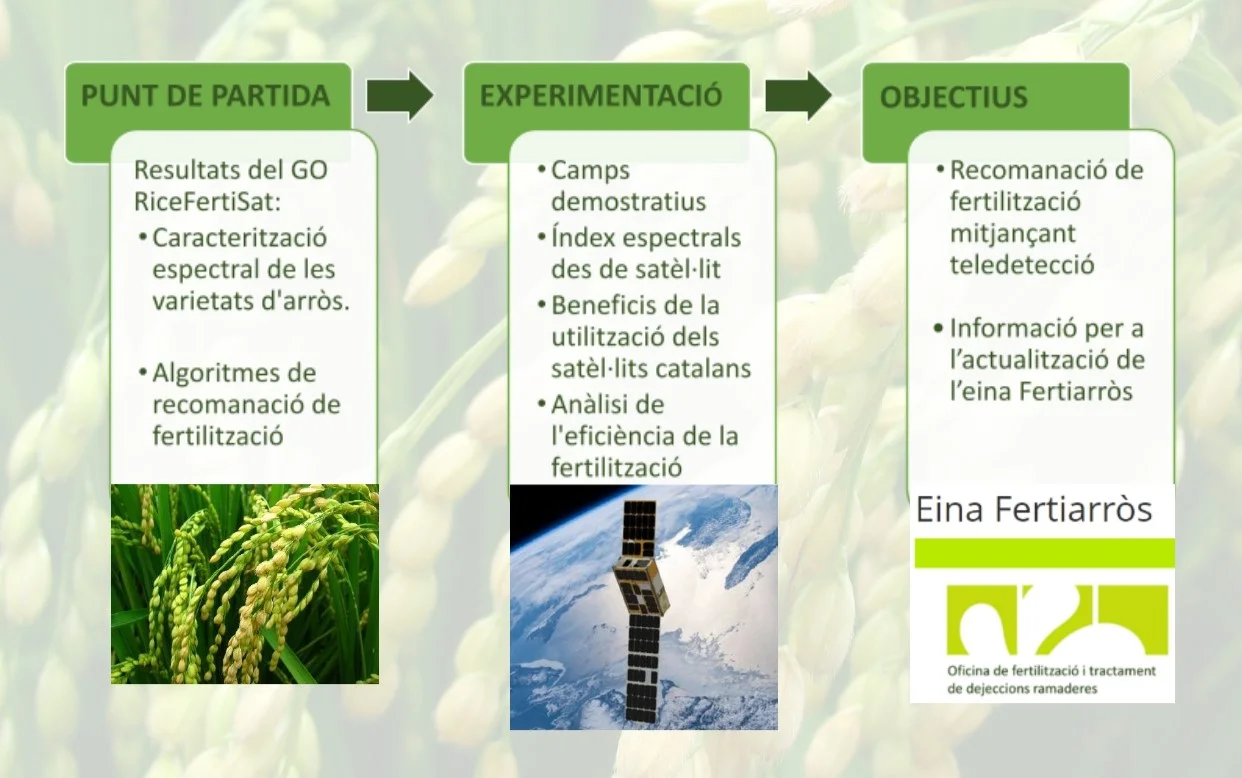
Rice cultivation has very high nitrogen requirements, as it is the nutrient that most affects yield. Within the innovative GO RiceFertiSAT project, and commissioned by the rice-growing sector of Catalonia, the Institute of Agrifood Research and Technology (IRTA) is carrying out a spectral characterisation of rice varieties and developing fertilisation recommendation algorithms.
The Demo RiceFertiSAT project, led by IRTA, aims to transfer this knowledge using satellite data, identifying crop needs to recommend top-dressing fertilisation and improve its efficiency. This practice must be made accessible to all rice producers in the form of a tool (for example, by integrating it into the existing tool of the Department of Agriculture, Livestock, Fisheries and Food of the Government of Catalonia, Fertiarròs). The ultimate goal of this demonstrative activity is to promote the sustainability of rice farms by optimising nitrogen fertilisation management.
A productive synergy has been established between the IEEC and IRTA to achieve these objectives. Our institute contributes expertise in satellite data processing, providing the project with the corresponding spectral indices obtained from Sentinel-2 satellite data and the available data from the Menut mission, while IRTA brings knowledge of rice cultivation, its fertilisation, and the fertilisation recommendation algorithms.
This initiative forms part of the 2023–2027 CAP Strategic Plan, co-funded by the Ministry of Agriculture, Fisheries and Food, the European Union and the Government of Catalonia.
TEAM
With the support of